
The Surface Ocean CO2 Atlas (SOCAT) is the global synthesis effort of in situ surface ocean fCO2 (fugacity of carbon dioxide) measurements. Its observations are made according to community-agreed standards with transparent and traceable quality control, allowing qualitative assessment of uncertainty in the data (SOCAT, 2026a).
The achievement of TRICUSO’s Milestone 25 is in support of the project’s objective to establish an international governance structure for surface ocean pCO2 observations, including strengthening SOCAT.
Want to read offline? Download the Milestone 25 Story.
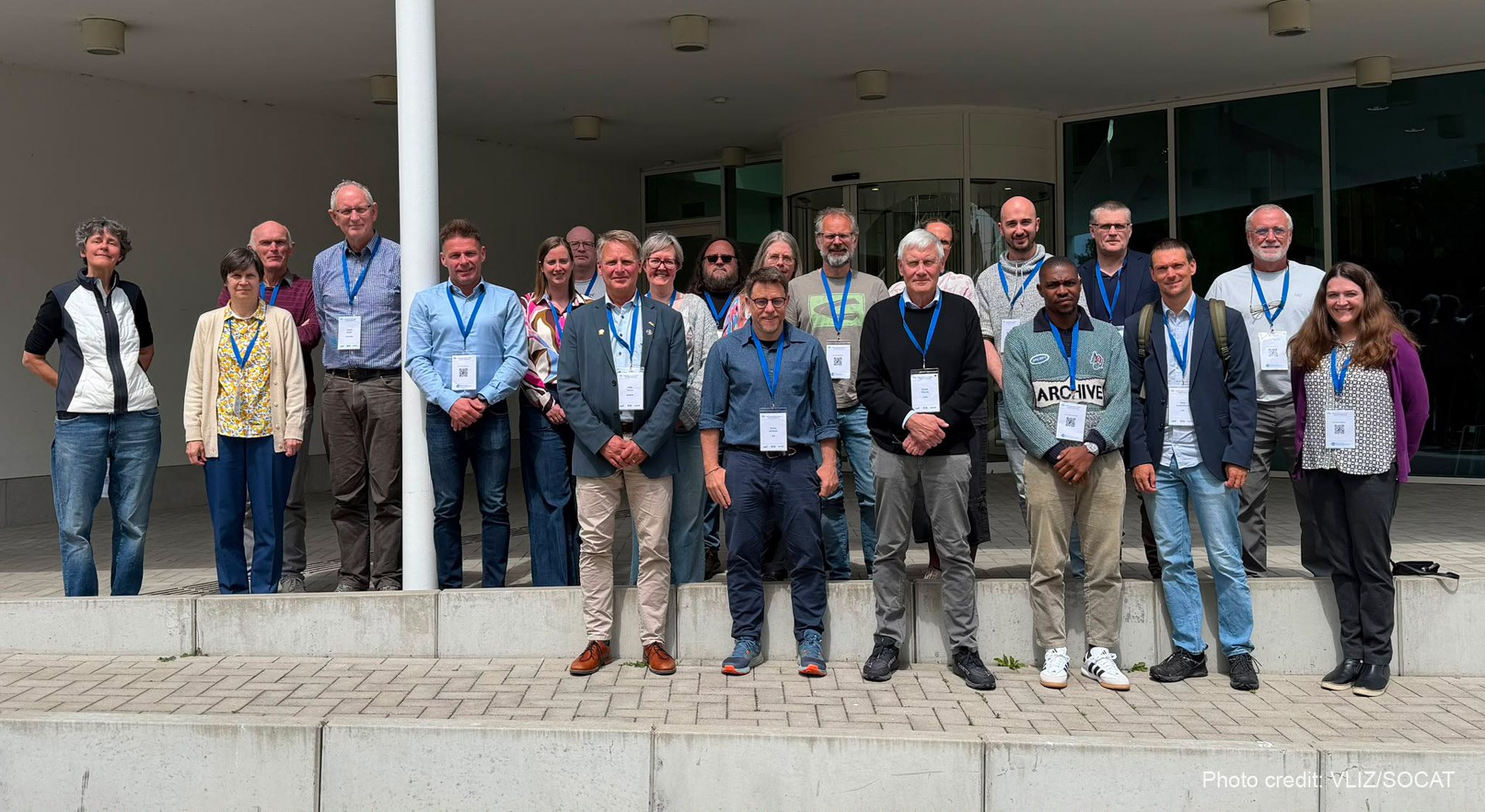
The SOCAT Steering Committee is the decision-making body of SOCAT and provides scientific leadership and oversight for the development and execution of the synthesis effort. Comprising members of the previous semi-formal SOCAT Global Group and guided by the newly developed Terms of Reference (ToR), SOCAT has now formalised its new Steering Committee, and the first four-year term commenced on October 1, 2026.
Why is this important?
Formal governance often helps unlock capital, and funding sources such as major foundations, government agencies or regional and international funders rarely fund informal collectives. In addition, when advocating for policy change or negotiating partnerships, a formal governance structure signals permanence and credibility. Decision-makers are far more willing to enter long-term contracts with an organisation that has an accountable leadership body rather than a less-structured working group.
Members of the Steering Committee
The first-ever SOCAT Steering Committee comprises international experts from seven countries across two continents, and is structured around one chair, seven additional science members and four ex-officio members.
Dorothee Bakker (Chair, Science Member, UK)
Members:
Alex Kozyr (Science Member, USA)
Are Olsen (Science Member, Norway)
Denis Pierrot (Science Member, USA)
Siv Lauvset (Science Member, Norway)
Thanos Gkritzalis (Science Member, Belgium)
Tobias Steinhoff (Science Member, Germany)
Vlad Alexandru Macovei (Science Member, Germany)
Four ex-officio members:
Kevin O’Brien (Ex-Officio Member, OceanOPS, France)
Linus Kamb (Ex-Officio Member, Data Management Hub, USA)
Maciej Telszewski (Ex-Officio Member, IOCCP, Poland)
Steve Jones (Ex-Officio Member, Coordination & Support Hub, Belgium)
Read more about the Terms of Reference (ToR) to learn about its formation and the responsibilities of SE members in the full Milestone 25 Report.
SOCAT Origin and Context
SOCAT was initiated in 2007 to develop SOCAT quality-controlled synthesis products. The first public release was in 2011 (SOCAT, 2026b), which has seen annual updates since 2015. Over the years, this community-driven effort was coordinated and governed by a semi-formal SOCAT Global Group, with support from leaders and members of regional groups who primarily focused on delivering annual secondary quality control for submitted data.
SOCAT data are trusted and transparent because they are delivered through an open, community-driven quality control and synthesis process aligned with FAIR (Findability, Accessibility, Interoperability, Reusability) data principles. The freely available, annually updated SOCAT synthesis and gridded products form the observational basis for open ocean and coastal carbon sink estimates generated by the Surface Ocean CO2 Mapping (SOCOM) program and others, and for ocean acidification assessments. The ocean sink estimates provide, together with the rate of atmospheric CO2 increase, an independent constraint on the land carbon sink. SOCAT data are used in the Global Carbon Budget, the World Meteorological Organization’s Global Greenhouse Gas Watch (G3W), Intergovernmental Panel on Climate Change (IPCC) reports, the Planetary Health Check, United Nations Sustainable Development Goal 14, the Decade of Ocean Science and other high-level policy- and management-relevant assessments. SOCONET, SOCAT, and SOCOM are linked international efforts that, along with additional critical data from satellites, models and re-analysis, enable the inclusion of ocean carbon and carbonate system information in these assessments. SOCAT products are used in circa 100 scientific publications per year. SOCAT is endorsed by GOOS (Global Ocean Observing System) of IOC (Intergovernmental Oceanographic Commission) of UNESCO), IOCCP (International Ocean Carbon Coordination Project) and SOLAS (Surface Ocean-Lower Atmosphere Study).
Read the full Milestone 25 Report by Maciej Telszewski, Dorothee Bakker (UEA), Siv Lauvset (NORCE), Kevin O’Brien (WMO), Are Olsen (NORCE), SOCAT Regional Group Leads, SOCAT Global Group members and other SOCAT contributors.


