


The four-year Horizon Europe TRICUSO seeks to enhance every level of the Southern Ocean carbon observation value chain from innovating sensor technologies and expanding observation capacities via autonomous and citizen science platforms, to data products and system governance in support of the WMO Global Greenhouse Gas Watch (G3W).
VOLUME THREE STORIES


Dear Readers,
As we leave spring on one side of the world, and a stormy autumn in the Southern Ocean slips into winter, we are reminded that TRICUSO is always working across seasons and hemispheres simultaneously. This has been a productive stretch for the project, and June looks set to be a highlight, with milestones arriving across sensor integration on autonomous platforms, observing system design, engagement with the racing yacht industry, and the first steps toward building an international governance structure for surface ocean CO2 observations. Each of these reflects a different layer of what TRICUSO is trying to achieve, and it is encouraging to see so many of them coming together at once.
The backdrop to all of this, of course, remains urgent. Atmospheric CO2 continues to rise, and the role of the Southern Ocean in moderating that rise, while critical, is still poorly understood. Every deployment, every validated data stream, every new integration with operational systems is a step toward closing that gap. That is easy to lose sight of in day-to-day work, but moments like submitting a milestone have a way of bringing it back into focus.
Wishing you good reading and fair winds,
Louise Delaigue
Sorbonne Université (LOV)
WP3 co-lead: Observing System Design & Strategy

Meeting Milestones - It's All Sail Time for TRICUSO

This past season has seen the achievement of many key milestones across TRICUSO’s technology and data management pillars, demonstrating technical innovations and successful trials in support of the project’s objective to strengthen the Southern Ocean carbon observation value chain.
MILESTONE 4: Long-term Lab and Sea Trials of the SubCtech OceanPack™ have been completed at GEOMAR. In support of Work Package 2, this milestone focuses on improving the quality of data returned by membrane-based systems through a long-term laboratory deployment under simulated in situ conditions, using a dedicated pCO2 validation unit.
MILESTONE 10: Defining the Optimal Float Network. This milestone has been achieved through the delivery of a new observation-based estimate of the Southern Ocean carbon sink south of 30°S, using machine learning to combine traditional ship-based measurements from SOCATv2025 with year-round data from autonomous Biogeochemical-Argo (BGC-Argo) floats. The work is in support of the Work Package 3 objective to reduce the uncertainty in observation-based estimates of Ocean carbon uptake by integrating complementary observing systems.
MILESTONE 12: European Trials of Wind Sensors on an Oxygen Float off of Villefranche marks the first European sea trials of a profiling float equipped with passive acoustic sensors that are capable of estimating surface wind speed from underwater ambient noise.
MILESTONE 15: Data Pathway from Float to Data Centre Operational was met with the above float being fully integrated into the operational Argo data system. Beyond demonstrating the scientific feasibility of passive acoustic wind retrieval, the deployment also confirms that these observations can be transmitted, processed and distributed through the existing Argo infrastructure, a critical requirement for any future large-scale implementation.
These milestones, led by Sorbonne Université (LOV), support TRICUSO’s objective of expanding the autonomous biogeochemical observing system through the integration of new sensor capabilities and data pathways, which is part of Work Package 4.
Stay tuned for new stories on achievements as more milestones are met. Find them on the project website throughout the summer.

Blue Tech Europe 2026: Conference & Policy Recommendation

The Blue Tech Europe programme aims to catalyse a sensor industry in Europe by fostering constructive dialogue between government, industry, research and investment actors. Co-funded and co-organised by TRICUSO through the contributions of colleagues Toste Tanhua (GEOMAR) and Nicolas Pade (EMBRC-ERIC), the two-day conference in Paris, France, brought together marine industry, researchers, marine observation experts, research infrastructures, and policy makers. A key highlight was the development of a policy recommendation outlining five key challenges that the community seeks to address.
Factsheet: TRICUSO at a Glance
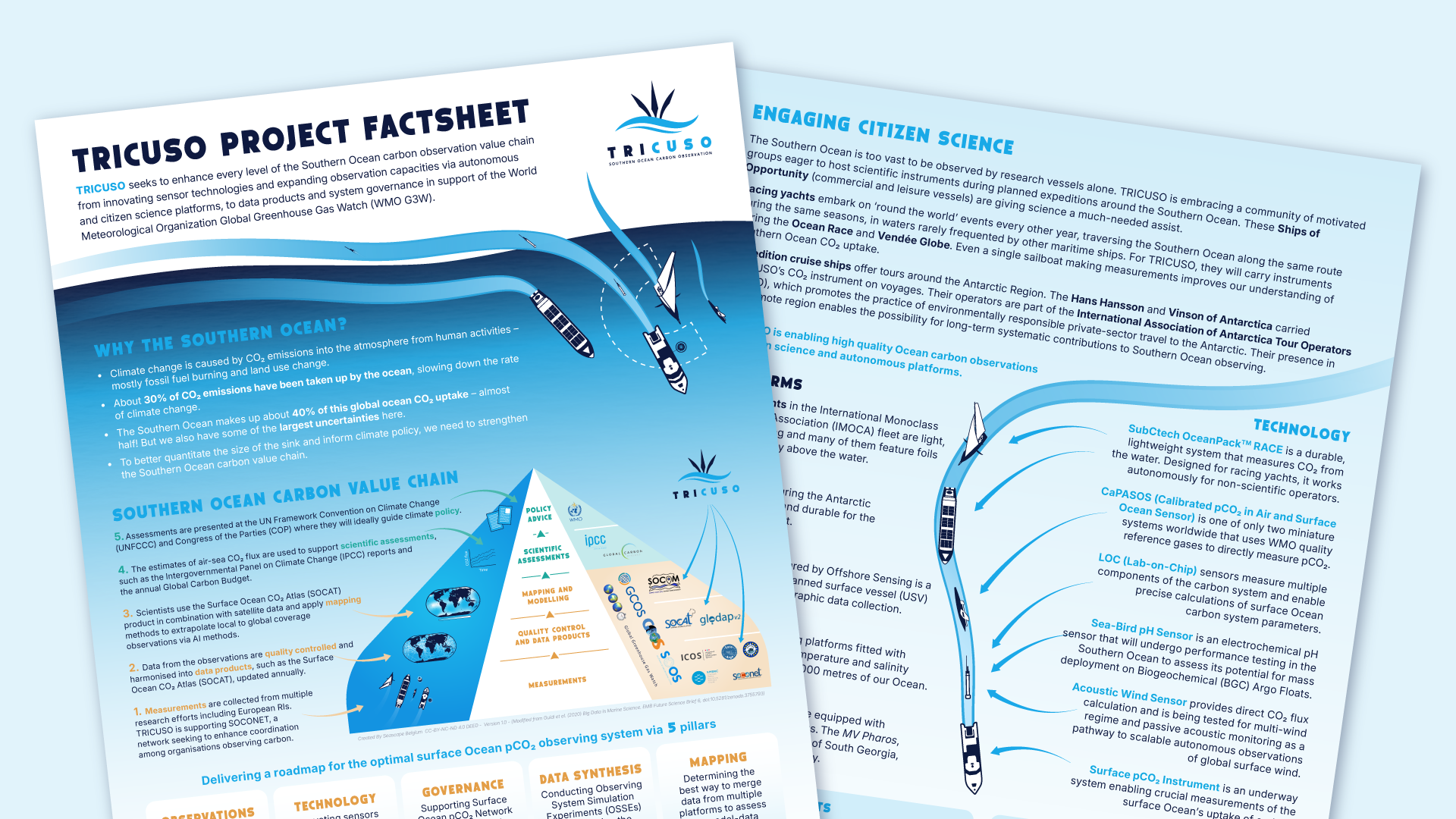
Our first factsheet provides an overview of how the project is delivering a roadmap for the optimal surface Ocean pCO2 observing system and features general project information, an outline of the science case TRICUSO is addressing and a look at the sensors and platforms being used to trial new observation design experiments. Available to download and share.
Supporting Ocean Literacy with EU4Ocean
TRICUSO has become a member of the EU Maritime Forum’s European Ocean (EU4Ocean) Coalition, a program that seeks to connect diverse organisations, projects and people to contribute to ocean literacy and the sustainable management of the ocean. EU4Ocean believes that “Understanding how we influence the ocean and how the ocean influences us is at the core of ocean literacy”; the coalition facilitates EU-wide activities with dedicated actions for all European waters. We are looking forward to participating in Ocean literacy events to share the TRICUSO story and promote its use of citizen science platforms in support of expanding observation in the Southern Ocean.

Meet the Vinson of Antarctica

Following the success of the Hans Hansson, a second citizen science platform has joined TRICUSO’s observation quest in the Southern Ocean. The Vinson of Antarctica is a polar expedition vessel, designed especially to sail in high latitudes. This April, she travelled across the South Atlantic from the Falkland Islands to South Africa for the Pelagic Adventure Sailing RYA Yachtmaster Ocean Course, equipped with TRICUSO’s OceanPack™ RACE instrument, enabling the measurement of CO2 in this under-observed region. Special thanks to our partner SAERI who facilitated the installation.
Key Instrumentation on the MV Pharos
Another great success for TRICUSO, the implementation of a surface pCO2 sensor – an underway system enabling crucial measurements of the surface ocean’s uptake of carbon has been installed on the MV Pharos. In collaboration with the U.S.’s National Oceanographic and Atmospheric Administration (NOAA), partners GEOMAR and SAERI conducted the installation in preparation for fieldwork later in the project. However, beyond TRICUSO this activity has a much broader impact. The Pharos samples a key region of the Southern Ocean and the installation of a semi-permanent observing system will open up a fuller understanding of the role of the ocean in regulating global climate; the implementation also supports a key engagement with the Global Climate Observing System (GOOS) of which we are very proud to have accomplished through TRICUSO. Thanks to all involved, especially the captain and crew of the Pharos who hosted Melf Paulsen (GEOMAR) in Punta Arenas, and the staff at SAERI who supported the installation logistically. Stay tuned for more information on this story which will be coming soon to the project website.


IAATO Annual Meeting

Lucie Knor (GEOMAR) attended the annual meeting recently in Maryland of the International Association of Antarctica Tour Operators (IAATO), which promotes the practice of safe and environmentally responsible private-sector travel to the Antarctic region.
TRICUSO is happy to be collaborating with IAATO and its Science Support Working Group to explore how cruise ships can be equipped with CO2 instruments to provide much-needed measurements in the under-observed Antarctic region. Two expedition cruise ships, the Hans Hansson and Vinson of Antarctica have already carried TRICUSO’s CO2 instrument on voyages.
DOOS Annual Meeting 2026
Jacqueline Behncke (GEOMAR) gave a presentation at the annual event for the Deep Ocean Observing Strategy (DOOS) earlier this month. Her talk, focusing on improved air-sea CO2 flux estimates from sailboat measurements, was in support of the meeting’s theme: Building a Global Ocean Carbon Observatory.

Optimal Ocean Carbon Observing Design Workshop
Ostend, Belgium: 10-11 June
In support of developing an optimal surface ocean pCO2 network design as requested by WMO Global Greenhouse Gas Watch (G3W), a workshop will take place at partner VLIZ. Co-funded by TRICUSO (with IOCCP, GOOS, NOAA-GOMO and VLIZ) the agenda will focus on surface ocean pCO2 design, leveraging the momentum of experiments currently being conducted by the Surface Ocean pCO2 Mapping intercomparison project (SOCOMv2) and will begin the scoping process for next steps in interior Ocean carbon observing design.
Polar Argo Workshop
Hybrid event: UBO/IUEM/PNBI, Plouzané, France & online: 18-19 June
Polar Argo floats have proven their ability to perform high-quality, cost-effective, broad-scale observations of the seasonally ice-covered ocean. This hybrid workshop will address the implementation of the Polar Argo array, review scientific advances in the Southern and Northern hemispheres and discuss float technology and data management protocols to address current challenges including funding pathways, under-ice positioning capability and observational gaps.
Thank you for reading TRICUSO Currents. The next volume will be out in August.


